


2022 Fall Picnic
2022 SLAGA Christmas Party
Bellefontaine CITO November 2022
Cachemas 2022 Bonus Day
SLAGA at GeoWoodstock 2023
2024 SLAGA Spring Picnic
2025 New Year's Day Hike, Fort Bellefontaine
Cachetur 101 Class - March 2025
2025 Winter Potluck
2025 Spring Picnic
2025 Spring Picnic
2025 GigaStock in Morgantown WV
2025 GeoWoodstock, Morgantown, WV
SLAGA at Ted Drewes 2025
2025 Christmas Event
2026 NYD Hike
Crazy Beards!
2026 Winter Potluck
Busch Wildlife/Weldon Springs permit manager
- Details
- Written by Kathy DeWitt
- Hits: 4344
We have a new contact for geocache permits at Busch Wildlife/Weldon Springs.
Mr. Raenhard Wesselschmidt
email This email address is being protected from spambots. You need JavaScript enabled to view it..
phone: 636-300-1953 ext. 4132.
We will try to get a blank permit to have posted in the permits section (lower left side of web site)
Caching in the Cold 🥶
- Details
- Written by Terri Nealon
- Hits: 2271

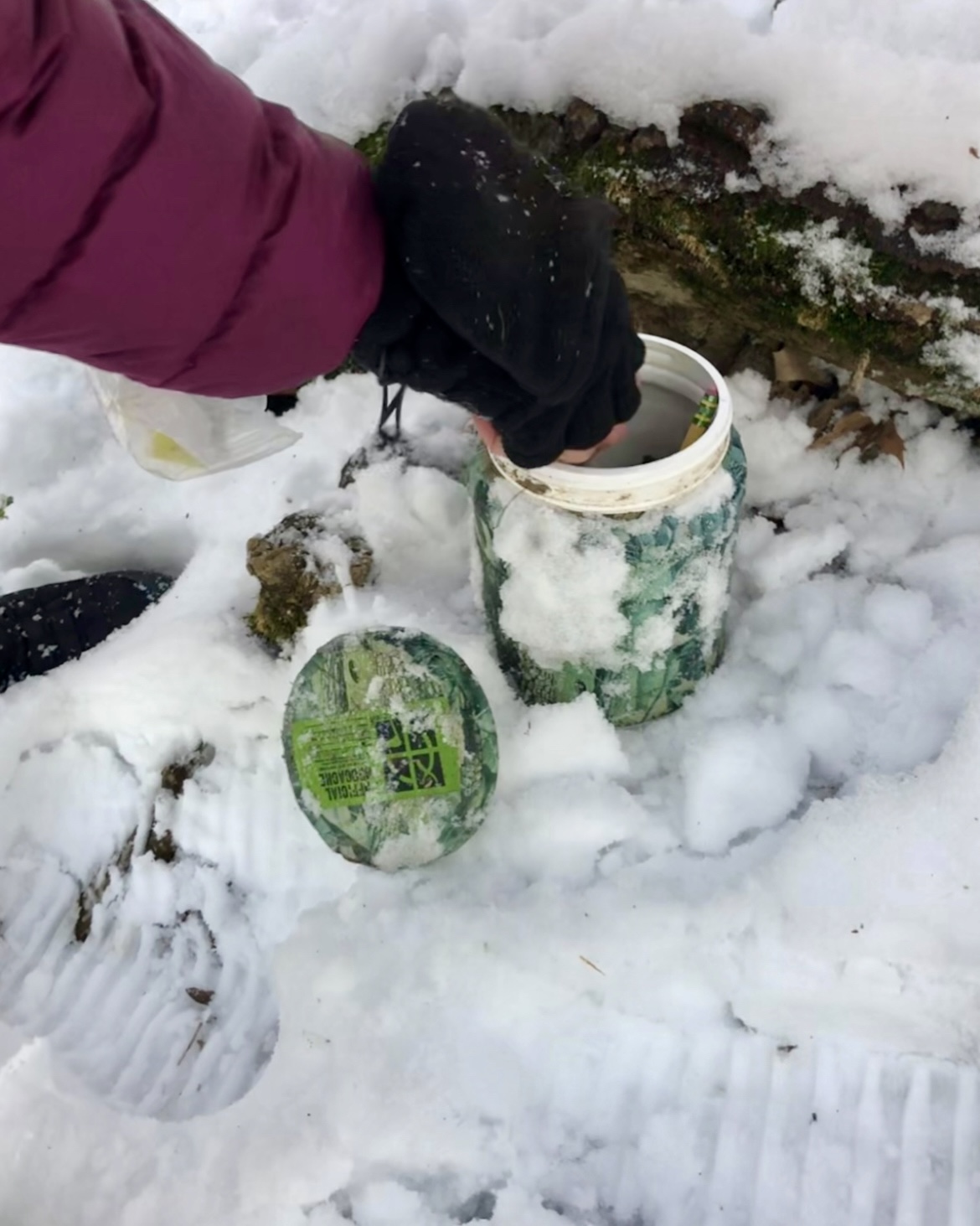
There is nothing like bundling up head to toe for a hike in the crisp winter air, through a forest blanketed with snow. The beautiful scenery, lack of bugs, spotting animal tracks, and uncovering nearly frozen geocache containers, hidden under a foot of snow, makes caching in the cold a worthwhile and fun adventure. But being prepared for winter caching is a must, because you leave behind the warmth, shelter, food, water and other comforts of home.


Before you head out for a hike and geocache find, in this beautiful cold world, keep in mind several winter hiking and geocaching tips and essentials. Obviously the longer the adventure and more intense the winter bushwhack, the more of the following information will apply, but it's good information regardless.
Begin at home by checking the weather conditions during your trip outdoors. Then see if the geocaches you're interested in finding are actually available and able to be found. Check the cache page attributes and recent logs. Remember too that some trails are closed in winter, or not marked and maintained. so route-finding skills are important. Plan and know your route because snow-covered landscapes look very different than in those warm dry months. If creek crossings are required, remember thin layers of ice on water can be decieving and dangerous, so don't count on walking across unless you know the freeze is over a long period of time and the ice is indeed thick.


WTWWTW's Signature Micro Container
- Details
- Hits: 4973
Summer 2017 has already been declared an especially bad season for ticks
- Details
- Written by From AOL News
- Hits: 3971
From AOL.com News
As the warm summer months draw dangerously near, experts have started warning the public about a tick-borne virus on the rise that can
have much deadlier consequences than Lyme disease.
The Powassan virus (POW) is a rare but serious disease that can be spread to humans by infected ticks quickly after the initial bite.
For comparison, while it takes a tick carrying Lyme disease nearly 24 hours to pass the infection on to a human host, a tick with POW can transfer the virus in as little as 15 minutes.
Once a human has contracted the disease, POW can cause severe inflammation of the brain and the membranes that surround the brain and spinal cord.
Due to the severe neurological impact of the disease, about 10 percent of all POW cases are fatal, with about 50 percent of cases resulting in permanent brain damage.
According to the CDC, only 75 cases of POW have been reported in the United States over the past 10 years, with most occurring in the northeastern and Great Lakes regions of the United States during the late spring, early summer and mid-fall when ticks are most active.
Although that may seem like a pretty limited scope, experts remain on high alert, considering summer 2017 has already been declared an especially bad season for ticks due to the mild winter and growing deer and mice populations.
"The bottom line is that we should be very scared of it because nobody is safe from it," said Dr. Jennifer Lyons, chief of the division of neurological and inflammatory diseases at the Brigham and Women's Hospital.
As there is currently no vaccine or cure for POW, the CDC recommends taking preventative measures to avoid contracting the potentially deadly virus, such as avoiding wooded and bushy areas and using insect repellent.
It also recommends conducting full-body tick checks after returning from such areas, and trying to remove any ticks immediately before they have a chance to bite..
Click here for a file from the CDC about tick bites and thier diseases.
Beware of Ticks!
- Details
- Written by Denmother
- Hits: 5601
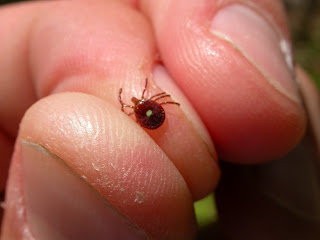 With the mild winter we had in SLAGA territory, we expect the ticks to be out in force this year! As a public service, we're reprinting part of a great article that Brawny Bear wrote a few years ago about ticks and how to avoid them. L Frank and I follow Brawny's advice and treat our caching clothes with Permethrin every year, and we swear by it. The brand we use is Hartz UltraGuard Plus Flea & Tick Home Spray. Here is an excerpt from Brawny's article:
So that some of the people new to caching and the outdoors understand the reality behind ticks, I have put together a primer to help you out. There is a great article in Backpacker magazine that covers ticks and how to avoid them.
When a tick buries its head into your skin, it forms a cement bond that keeps it in place while it excretes a chemical that breaks down tissue and allows them to absorb the blood and fluids they desire. There really isn't any documented length of time a tick can wait for a host. Some ticks will have several hosts as they morph from a nymph to an adult and others will have one host. Ticks have been known to live over 3 years, even through the dormant Winter, without ever attaching to a host.
A quick overview of the cycle of a tick is as follows...
Female lays eggs, Eggs become Larvae, Larvae attaches to birds or small mammals, Tick becomes a nymph, Nymph attaches to a host, Tick feeds until it becomes an adult, adult males detach and look for females usually on the host, male breeds and then drops and dies, female continues to feed, eventually dropping off and laying eggs. In some cases, the female will lay eggs on the host.
Identification
In Missouri, we have all 3 species of ticks.
1) Deer Tick - often called seed ticks and are very small. Females are bigger and often are 2 tone brown with the head and back being darker than the legs.
2) Lone Star Tick - Most common in Missouri. Females have a white dot on their back. This is where they get their name. A big misconception is the males have a spot too. This is not true. Males are the most common tick and often called a dog tick or brown tick. These ticks are more round than oval. Almost all ticks here in Missouri are Lone Stars.
3) The American Dog Tick - These are the largest ticks and they are more oval than the other ticks. The male and female are almost the same size. They are brown with darker brown spots on their backs. The adults are usually the ones
that feed on us and dogs.
Lone Star and Deer Ticks carry Lyme. Dog ticks do not but they can carry other diseases.
Prevention
Wear Light Clothes when in the field. I can't stress this enough. People who head out into a field with dark clothes are going to get skin buried ticks. Light clothes has them show up easier and you can pick them off.
Tuck your pants into your socks and tape them with some duct tape if possible. This keeps them on the outside. Also wear shirts tucked in and make sure they are light colored as well. Some people talk about ticks dropping from trees overhead. While this may be possible, it is highly unlikely. These critters are ground dwellers that usually get no higher that a weed. Birds love to eat ticks so climbing a tree would be like marching into the oven.
Spray your clothes with Permethrin. You can buy Cutter's and other brands of this but I use Equate brand Bedding Spray from Wal-Mart. Same stuff only a buck cheaper. Spray clothes until moist and allow them to dry completely. Spray shoes, socks, pants, shirt, undies, etc... It will last a couple of washings and a few rainy days.
Carry a spare set of shoes, socks and pants in the vehicle. If you can, change clothes and place your clothes into a plastic bag and put them in the trunk. When you get home, pop them in the dryer on high for 10 minutes. This will ensure all hitchhikers are incinerated.
Do a tick check often. When you get home, have your significant other check for all sizes of ticks. Remember, some may be smaller then a pinhead. If you do not have someone that can check, use a mirror.
Obviously, avoiding high grass and marshy fields would be the way to go...
Page 37 of 40